Join me for ...

Join me for ...
... a journey through some of the most beautiful landscapes of Greece
... wanderings through the less traveled mainland and islands of Greece
... a pilgrimage into the deep vistas of the land of the gods
Showing posts with label Cyclades. Show all posts

Saturday, May 30, 2015

Sifnos: Stairway to Heaven

Of all the islands in the Western Cyclades, some say Sifnos may be the most “spiritual.” There is a church with fresco interiors where it is said angels come to sing before the priest starts his service, there is a bay so serene it appears to kneel before you, and there is a stairway beside a brilliant, white-washed monastery that is rumored to lead to, well… heaven.


And all of these enchanting places are easily accessible from Dina’s Rooms in the island’s main port of Kamares. Dina’s rooms are on a horseshoe-shaped bay on the quiet side of the gentle body of brilliant blue-green water. It is a perfect setting for those wanting peace and solitude, but just a short walk to the shops and tavernas and the bus stop across the bay.

During the day, one can sunbathe on the veranda (or on the nearby beach or rocks just minutes away) and in the evening it is pleasant to view the bright lights of the tavernas and the famous “Captain’s Bar,” on the other side. Yachtsmen come from all over Greece to have a drink with the captain and party into early morning hours. Guests at Dina’s are happy they are on the opposite side of the bay!

The Arguras Restaurant and Taverna is next to Dina’s Rooms and it is without a doubt the best restaurant in Kamares and one of the best dining spots on the entire island. Fresh fish is served daily and the catch comes directly from the morning boats. Arguras, the owner, will grill a fish to perfection and his wife, Stella, makes a variety of Greek specialties for the afternoon and evening meals. Guests are invited into the kitchen to make their selections.

Sifnos is a mountainous island with small valleys filled with olive and almond trees and numerous beaches with thin, golden sand. It has a triangular shape of seventy-four square miles and a perimeter of twenty-eight miles.

Kamares is centrally located and a bus near the newsstand will take one to many points, including the port of Faros, within ten to twenty minutes. Photographers come from all over the world to take pictures of the famous monasteries, particularly the Monastery of Panaghia Chryssopighi, a magnificent snow-white structure with the stairway to heaven. It sits dramatically on a rock that some say was split during a miracle performed by the Virgin Mary, patron saint and protector of the island. Sifnos is approximately five hours by boat from Piraeus, and the trip is shorter by Flying Dolphin. Connections can be made easily to the nearby islands of Paros, Syros, Kythnos, Serifos, Folegandros, Sikinos, and Santorini. Boats also leave regularly for Crete, Ios, and the Dodecanese.

Sunday, May 3, 2015

A Magical Night on the Sacred Island of Delos


All guide-books and all guides will tell you that no one is allowed, by law, to stay on Delos overnight, but there is a wonderful story about how

LAWRENCE DURRELL, THE FAMOUS PHILHELLENE AND ENGLISH AUTHOR, MANAGED TO DO THIS AND HAVE THE MOST MAGICAL NIGHT OF HIS LIFE.

In his book, “The Greek Islands,” Durrell explains how he gained the cooperation of a boatman, practiced a slight deception on the men guarding Delos, and spent a romantic and spiritual night on the sacred island under the protection of Apollo himself.

Durrell hired a boatman named Janko to take him and his wife to the Bay of Phourni, below the old site of the abandoned Aesculapion. He had with him a sack that contained beer, bread, meat, and fruit and he also had sleeping bags. Janko dropped them off early in a very secluded area and then left. This was not unusual and it did not alert the guards, because it was the custom for small boats to drop visitors off, then return in the early evening to take them back.


The boatman came back to Delos, as Durrell planned, but then returned to Mykonos without his passengers. Janko’s part of the deception was to make sure the guards saw the boat leaving; he knew the guards would assume passengers were on board, but they were not. Durrell said the evening was perfect with Apollo protecting them, Zephyr controlling the calm breezes, and Aphrodite orchestrating the sunset. They swam nude by the rising moon and came back to drink the warm soup and coffee from the thermos flasks thoughtfully brought by Janko.

As dusk fell, they snuggled in their sleeping bags, but were awakened at midnight by the brilliant, white light of the moon. Deciding to prowl among the ruins, they climbed over rocks and through barbed wire, and did not need lights because, according to Durrell, “we could have read a newspaper by the moon’s light.”


They came upon what must have been the floor of a villa and, by the light of the moon, saw what looked like an ordinary fish design. Durrell went to the sea for a pail of water, splashed the seawater over the floor, and, like a photograph developing in a tray, the head of the most beautiful dolphin emerged. It was one of the famous mosaics that would be viewed by the public in later years, but he and his wife saw it long before others.

Durrell described Delos as “silent and ominous” at night with snakes and lizards slithering about, but he said it was also magical. When the moon gave up its brilliance, they managed to sleep once again and in the early morning the boatman returned. Reluctantly, they boarded the boat this time and returned to Mykonos.

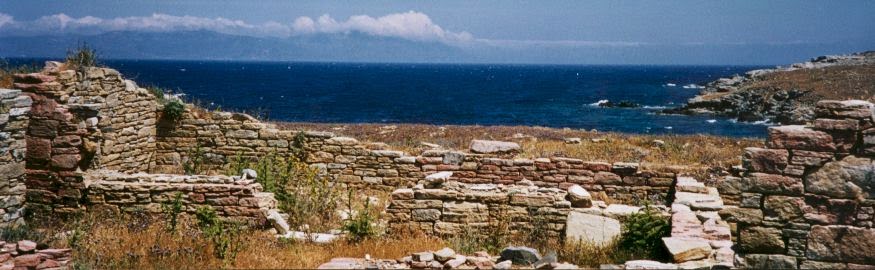
The island itself is relatively small—six kilometers long and 1,500 meters wide, but is monumental in Greek history and mythology and was one of the most important and glorious civilizations the world has ever known. Delos is not only the geological center of the Cyclades, but was

THE COMMERCIAL, RELIGIOUS, AND CULTURAL CENTER OF ANCIENT GREECE.

Delos is the birthplace of Apollo, the god of light and his sister, Artemis, goddess of hunting. They were born under a palm tree to Leto of the lovely hair who was impregnated by Zeus. Zeus chose Delos for the birth because he had to find a sanctuary for Leto, far from the eyes of his jealous wife, Hera. Delos means “that which appeared” and was so named because it suddenly appeared in the waves and sheltered Leto from Hera’s eyes. That is the wonderful myth of Delos.

History tells us, however, that the island was probably first inhabited in 3000 B.C. and at the end of the fourth century it developed into a major commercial center, competing with Rhodes. By Roman times, Delos had roughly 25,000 inhabitants. Archaeologists uncovered evidence of Ionians living here in the 7th century B.C., followed through the centuries by Athenians, Delians, Egyptians, Syrians, and Romans.


It was the jewel of the Aegean Sea and was the summer home of the rich and famous of the time. It was magnificent and majestic. Rumor has it that Cleopatra had a summer home here, but there is no archaeological evidence to support it, although the search goes on.

Delos’ rule over the sea was established around 478 B.C., when a Delian confederacy was formed to bring neighboring islands under its influence. Lavish festivals were held every five years to honor the gods, large barges brought animals from neighboring islands for sacrifice, and the most nubile Delian maidens were chosen to dance and sing hymns in honor of the gods.

The island was once a burial ground for Delians, but sometime around 426 BC. , in order to secure the favor of Apollo and incidentally, to gain control of the shrine’s treasurers, the bones of those who died there were removed to Rhinia, a nearby island where a new burial ground was created. Also, from that point forward, women who were about to give birth were taken to Rhinia for the occasion. In effect, no one was allowed to be born or to die on the island.

The island’s fall was sudden and brutal. In 88 B.C.. during the Mithriadic War, all inhabitants were slaughtered and the mansions and temples desecrated and demolished. Next, an army of barbarians burned the island and for years after that pirates came to pick over the remains. It was not until late in the 19th century that archaeologists began excavations that revealed the glory of Delos and encouraged the Greek government to establish strict rules for this site.

The French School of Archaeology began excavations in 1872 and in 1904, what is known as “the great excavation” took place. This is when many public buildings and private houses were uncovered and some were partly reconstructed. Work is still in progress. Five of the magnificent nine lions that are symbols of Delos have been removed to a museum to protect them from corrosion and the proud lions one sees now on the Avenue of the Lions are casts of the originals.

TELOS

This article was published on Hellenic Lifestyle ... Celebrating Greek Spirit

Wednesday, April 15, 2015

Aphrodites Hideaway


Where the Muses come for Inspiration

Of all the unique architectural features that distinguish St. John Mykonos Hotel, the stunning five-star luxury resort on Mykonos, none is more iconic than the graceful, chalk-white bridge that begins at poolside and takes you into the Aegean Sea. Through the morning mist, I could see the figure of a slim young woman in white standing on the crescent-shaped overpass. Like Aphrodite, she seemed to be rising from the foam of the sea. She was framed against the rosy-fingered dawn, rising in slender waves of orange and purple ribbons, tossed across the sky.


Thus was the serene view that greeted me on my first morning in my commodious suite at St. John, the relatively young resort hotel that is the jewel in the crown of luxury accommodation on Mykonos, the most cosmopolitan of the Cycladic islands in Greece. Its location, accommodations, spa, cuisine and services are the best the island has to offer.

Surely, the gods have smiled upon me, I thought. Mykonos is my favorite of all the islands and here I was on a hillside where the land cascades into the sea. The location provides a panoramic view of both Agios Ioannis and the Aegean; it is flawless. The hotel’s beach was chosen as the setting for the cult classic movie, Shirley Valentine, one of the most endearing films about Greece. It is the story of a bored woman from a dreary town in England who comes to Mykonos and discovers sunshine, living in and relishing the moment, and love.

Each morning, the view from my balcony was distinctive, and on my second day I saw a shadowy outline in the sea’s deep vista. As the morning mist rose, the grey outline of the sacred island of Delos was revealed and it beckoned me. I learned I could arrange a private tour of both Delos, the sacred island where warriors fought heroic battles centuries ago, and also of Rhinia, its sister island, where the bones of the warriors are buried. By Greek law, no one is allowed to build on either of these islands.

The boat trips sounded appealing, but I was feeling mellow and decided that after breakfast, I would spend at least the morning at the Aphrodite Spa and Beauty Center, the tranquil space that is the very heart of the hotel. After studying the list of the spa’s extensive services, I promised myself a day of relaxation and revitalization and was not disappointed.

The spa is a gathering spot, especially for female guests. They come to use the sauna, Jacuzzi, steam bath, and heated pool, and to enjoy invigorating massages, mud baths, aromatherapy, thalassotherapy and the beauty services. They assemble, also, to have conversations with the “hostess” of the spa, the most personable Evgenia Rather Kosathanas. She is lovely wife of Thanasis Kousathanas and daughter-in-law of Yiannis Kousathanas, founder and owner of St. John Mykonos. The spa has a soothing, welcoming atmosphere and guests soon become aware that the ambiance reflects Evgenia’s thoughtful and tranquil personality and genial hospitality.

Over the course of my one-week stay, I visited the spa daily and had a variety of treatments, including relaxing massages and the most perfect pedicure I have ever enjoyed. It was pleasurable to splash about in the soothing warm waters of the indoor pool and then relax on a lounge chair, listen to soft music, and read my books of Greek poetry. Bliss.

In the evenings, I was in “Seventh Heaven”—literally. This is the hotel’s premier gourmet restaurant where dining is an art. I chose entrees recommended by the chef and my palate was always pleasantly delighted. The Greek wines never disappointed and were chosen from the hotel’s exclusive cellar. Indeed, my days were serene and my evenings mellow.

The location of St. John Mykonos is dramatic. It is perched on a hillside on Agios Ioannis, one of the most desirable locations on the island, offering stunning views of the setting sun, the Aegean Sea and Delos Island. It is an architectural masterpiece created to offer guests the finest in luxury travel. Accommodations range from executive rooms and junior and family suites to secluded villas with private pools. The hotel’s private beach extends over 200 meters and a tennis court is available for guests desiring stimulating physical activity. There are seven restaurant and bars, including areas for casual, poolside dining and fine dining.


The reputation of St. John Mykonos as an ideal location for conferences is growing and it now has two indoor halls that can accommodate 450 delegates. These are The Pelagos Conference room, accommodating 100 persons theatre-style or 60 persons classroom style. The larger Zeus meeting room is for larger groups up to 350.

All equipment needed for professional presentations is available, allowing guests to relax with the knowledge that all is in good hands.

Professional organizations from all over the world have chosen to hold their conferences at St. John Mykonos and its desirability has spread by the time-honored method of “word of mouth.” Guests come from far and wide, also, to hold their weddings in a spectacular setting that will be unforgettable. All planning, from the catering, seating, floral arrangements and photography is done by the hotel’s professional event-planning staff. Arrangements can be made for a local priest to perform the ceremony; most guests choose to include the final touch, which is a brilliant display of fireworks.


Unfortunately, there was no wedding during my stay and I did not get to see the fireworks, but I did see the sunset, I swam in the sea and in the pool, I had lunch by the pool bar and dinner in Seventh Heaven, I had luxurious days at the Aphrodite Spa, I felt the energy radiating from the sacred island of Delos, and I had my photo taken on the chalk-white bridge. I pretended I was the goddess Aphrodite, rising from the foam of the Aegean Sea. Why not? At St. John Mykonos Hotel, all things are possible.

Please visit the hotel’s website at www.saintjohn.gr and contact the hotel by sending an email to info@saintjohn.gr.

All images are courtesy of St. John Mykonos Hotel

This article was published in the April edition of Luxe Beat Magazine

Saturday, August 9, 2014

Trekking to Naxos and Amorgos

Alpine Travel of Crete has a new outdoor, fourteen-day trekking adventure during the months of May to October on the islands of Naxos and Amorgos. This has been specially planned to enable you to visit sacred sites and monasteries difficult to find on your own. It is classified as a “moderate” trek for those with Level Two hiking experience who enjoy walks of four to five hours a day.

The adventure will be varied and include breaks for swimming in remote, crystal clear waters, but the purpose of the adventure it to take you to the peaks where you can visit ancient sites, chapels, and monasteries.

The itinerary for the fourteen-day adventure includes:

An overnight stay in an Athens hotel, and a visit to Plaka and the Archaeological Museum before boarding the ferry to Naxos for your first hike up to Apano Kastro, a 9th century Venetian Fort and also Halki. You will spend time exploring the village of Apeiranthos and Minoa, the ancient site overlooking Katapola, and also the monastery of Varsamitis.

On Amorgos you will walk through the picturesque streets of the town (Chora) and follow the trail leading to the chapel of Profitis Ilias where you will have a magnificent view overlooking the island of Amorgos. You will also visit the monastery of Chozoviotissa, one of the most famous sights on the island, and continue on the path to Aegiali for a swim.

Hikes through the two islands of Koufonisi the village of Tholaria, the church of Stavros, the ancient site of Arkesini, are included in the adventure, as is a hike up the highest peak of the Zas mountain on Naxos to visit the cave of Zeus. When you arrive at the top, you will have incredible views of the Archipelagos and the entire island.

For further information, please visit www.alpine.gr

Published in The National Herald, July 2014

Santorini’s Pension George: the Dream

George Halaris was only sixteen in the early 1970s when he was working on a cruise ship in the Aegean touring the Cycladic islands, admiring their beauty, but acknowledging that in his mind nothing could compare to his beloved Santorini. Tourism had not blossomed as yet, but the young man recognized that the natural beauty he saw as he sailed from island to island had enormous potential as a tourist destination.


One of ten children, Mr. Halaris worked long and hard hours from 1973 to 1982 on the cruise ship Stella Oceanis, with a break for compulsory National Service in the Navy. All this time he dreamed of his roots in the volcanic soil of his village. “I was constantly homesick,” he explains.

Same-Species Marriage Legal on Mykonos


Petros, a proud and stately pelican, is the famous mascot of Mykonos, if not the most famous mascot of the Greek islands. His mate is the lovely, pink-feathered Irini. It is said that sometime in the early 1990s they were joined together in a marriage ceremony on the harbor with a fisherman wearing a top hat performing the “rites.”

Guests, who were told beforehand that the fisherman would be in “formal attire,” came dressed in their finery. Here is the back-story but first, in the interests of full disclosure, it must be revealed that it was an arranged marriage.


The birds would meet for the first time on the harbor at the ceremony. While Irini waited there pacing nervously, Petros, who many feared would be a reluctant participant, was brought to the harbor in the mayor’s limousine.


Fears were quickly allayed when Petros hopped from the limo, went directly to Irini, raised his head and massive beak skyward and made loud, squawking sounds which the guests described as “joyous.” Irini, who was sometimes bad-tempered, stood regally aloof during the mating call. Then, to the delight of the crowd, she made the first move, nudged Petros with her neck, and led him to the basket of fish awaiting them. On cue, the fisherman declared them “wed” and threw his top hat into the air. Musicians played N’ Agape (love me), and everyone danced. It is said that the pair became inseparable, like lovers in paradise. On Mykonos today, you will see them strolling on the harbor, enjoying morning and evening swims, and having lunch or dinner at whatever taverna offers the best and freshest baskets of fish.


Petros is really Petros II. The first Petros was an injured bird washed to the shore, rescued by a fisherman and nursed back to health. He became a beloved pet of the locals for many years until he passed away in 1985. In the early 1990s a travel agent found a bird in Germany, named him Petros II, and sent him to Mykonos as a replacement for the beloved original.

Irini was already on the island when the new bird arrived, creating the impetus for the locals to arrange a “marriage.” Today there are three pelicans (and possibly more) on Mykonos, each well loved and each responding to the name “Petros,” because while most visitors to the island know that Petros is the mascot, few know the story of the arranged marriage. So please, keep the secret.

TO TELOS (THE END)

Published in The National Herald, April 2014

Friday, August 8, 2014

Fun Jobs in Greece for Free Room and Board – All Summer Long and Beyond

Would you be willing to care for horses on a farm in Corfu, help someone build a storehouse on Chania, serve as a maid for a small hotel on Naxos, or pick and clean acorns that fall from trees on the island of Kea–all in exchange for room and board?

Do you fancy donating your services for a few months, or do you prefer a year? Welcome to the world of “Help Exchange,” or “HelpX,” an online listing of opportunities that may be a match for you.

“HelpX” is “a cultural exchange for working holiday makers.” Its website lists farms and lodges willing to hosts volunteers for a few months or a year in return for room and board. Some of these opportunities require basic “handyman” skills, but others able to pick and process olives or acorns are welcomed. Hosts look for individuals with a sense of adventure who will enjoy learning new skills and living among the locals. Below are just a few current listings:

Art Space Winery of Santorini


One enters the Art Space Winery of Santorini in Exo Gonia through an underground cavern eight meters below the earth’s surface. Its carved chambers of pumice rock are a work of art and visitors with discriminating eyes will know that the age of this ancient grotto can be seen in the caves and cisterns formed by the island’s unique volcanic ash.


Art Space Winery is, as its name implies, a place for art and a place for wine. Hundreds of artists from all over the world have exhibited their paintings, photographs, sculptures, and jewelry here. It is a working winery producing more than 10,000 bottles of fine wine each year.


 Traditional wine making equipment is on display along with artifacts from a winery in the same location dating back to 1861.


The Museum tells the story of the history of wine making and the craftsmanship employed. The vineyards of Santorini are said to be among “the oldest in the world,” and perhaps its longevity is due to its unique volcanic soil, known to be resistant to the dreaded fungi or insect infestation that have plagued and destroyed many a vineyard.


The Art Space Winery has several features contributing to the production of high quality wine. First, the grapes are organically grown. Secondly, the walls of the winery are dense layers of pumice, six meters thick, creating insulating material and a perfect environment for maturation and ageing of the wine.


Finally, the vinification—the conversion of grape juice into wine through fermentation–takes place on three different levels, thus taking advantage of gravity and natural flow without the use of pumps.


An old, pre-industrial winery that began operation in 1861 remained in operation until 1952 when its third owner, Nikolaos A. Argyros, closed its doors to establish SantoWines, the largest winery on the island. In 1999 Mr. Argyros’ son, Antonis, brought the old winery back to life and founded Art Space Winery.


Whether you are interested exclusively in wine or exclusively in art, you should not leave Santorini without visiting Art Space.


Where else can you wander through a cave, learn about the history of wine-making, see modern wine making in progress, and be treated to exquisite works of art. Indeed, it is a very special “space.”

TELOS

Published in The National Herald, June 2014 and on Hellenic Lifestyle ... Celebrating Greek Spirit

Special thanks to Art Space for all the photos. Visit them at www.artspace-santorini.com

Literary Festival on Tinos

A multinational gathering of writers and poets took place on the Cycladic island of Tinos during the island’s fourth Tinos International Literary Festival. The three day event ended July 26, and was a celebration of contemporary literature by writers from Cyprus, Greece, the United States, Mexico, Israel, Denmark, Croatia, Albania, and Kurdistan.

Dinos Siotis serves as Artistic Director. The Society of Dekata hosted the festival and co-organizers included the Tinos Municipality, the Pan-Hellenic Holy Foundation of Evangelistria of Tinos, and the Tinos Cultural Foundation. Sponsors worked together to combine culture and tourism so that participants enjoyed both the works of various authors while exploring the beauty of Tinos.

In Cyclades: 2 Goddesses, 1 Temptress


The magic of Greece is in its very ambiguity, in the tensions that pull it from one wonderful, delicious extreme to the other. The senses are pleased and pampered by the serene beauty of Greece found in the depth of its vistas, the spectacular sunrises and sunsets, and the radiance of the light that even the poets cannot adequately describe. The senses are titillated and tempted, also, by Greece’s extremes of food and drink, flesh, nightlife, music, and the burning sun.

Perhaps this tension is best exemplified in the islands that form an ancient triangle in the very heart of the Cyclades. They are cosmopolitan Mykonos, Sacred Delos, and mysterious Rhinia. Taken together, these sisters with their distinctive and contradictory personalities give the visitor a tantalizing taste of Greece known mainly to Greeks who live in the Cyclades.

Within this triangle, one can sunbathe on some of the most beautiful beaches in Greece, literally dance until dawn at discos, take a magical, chartered cruise through the islands, go back in time with the ancients on an island declared “sacred” by the Greek government, or spend an enchanted day alone on an uninhabited island where gentle waves caress a pristine shore, luscious watermelons hang from vines, and where the pure air is so still you can hear yourself breath.


MYKONOS. Mykonos, the temptress, will seduce you with her charms. The occasional naughty sister is famous worldwide for her chalk-white beauty and vibrant nightlife. Sometimes called “Little Venice” or “The Capri of Greece,” Mykonos is considered by many to be the most cosmopolitan and sophisticated of the Greek islands and offers the very best in accommodations, food, and ambiance to the visitor.


DELOS. If Mykonos represents secular pleasures sought by the jet set, Delos is its opposite and the most sacred of the Greek islands. At the very geographical center of the Cyclades, Delos is its spiritual center as well and was the religious, cultural, and commercial focal point of ancient Greece. It was the jewel of the ancient world, a thriving commercial hub, and the “summer home” of the rich and famous of the time. Delos’ past glory is seen in the magnificent ruins and in exquisite, world-famous mosaic floors of the ruined palaces.


RHINIA. The third sister is Rhinia, a haunting, mysterious island four times the size of Delos and separated from it by a small strait. Called alternatively “Great Delos” and “Big Delos,” Rhinia is really two sections connected by a narrow isthmus. There are four, pristine, sandy beaches, each with its own characteristics, on the uninhabited island.


By Greek law, excerpt for a home built for a captain who supervised the quarantine of ships in the early 1900s, no one is allowed to live on this island or build a permanent home there; there is no running water or electricity and there are no roads on its rocky, hilly terrain. (There are rumors, however, of a few hearty souls who make the island their home in shepherd’s huts.) Very few tourists know about the island or have an interest in going there on a day’s excursion.


If you have a sense of adventure, it is possible to set foot on Rhinia. Simply go to the harbor of Mykonos when the fishing boats arrive in early morning and make a deal with a fisherman to take you there and bring you back. Back your bathing suit, food and wine, a blanket, and an ample supply of suntan lotion.

Published in The National Herald, December 2013

Winter Hiking on the Island of Kea


In my many decades of traveling to Greece, I have spent some winter months in Athens, but never on an island. I want to do this eventually—maybe next year–so I began my research, searching for an island where I could be active, but also discover more about ancient Greece. I immediately eliminated strenuous activity such as skiing and hiking, and while participating in the winter olive harvest on the island of Ithaca sounded interesting, it did not appeal to me.


I wanted an island close to Athens where I can take gentle walks through archaic ruins—my way of combining moderate physical activity with the pleasure of learning more about the ancient world. I searched through guide books and on internet sites to no avail until I consulted Matt Barrett’s Greece Travel Guide and found information on what for me would be an ideal winter holiday: rambling through the walking trails on the island of Kea.


According to Mr. Barrett: “The island of Kea has perhaps the best system of walking trails, most of them ancient, that connect the ancient cities on the island. While winter may not be the best time for swimming, it is the best time for hiking.” He describes it as “a hiker’s paradise,” with “the best system of walking paths and trails of any Greek island.” He says the landscape is varied, including “remote coves and ruins of ancient cities.” If, like me, you fancy walking tours on Kea during any season, please visit www.greecetravel.com for more information on the tours offered by Kostis Marulis, a guide living on the island.


The island of Kea is an hour from nearby Lavrion by ferry and is a good all-season island because of its miles and miles of ancient footpaths, clearly marked and kept up by the municipality. The Red Tractor Farms Guesthouse not only has comfortable rooms with fireplaces but they also provide guests with seasonal activities like olive-picking and production, wine-making and traditional crafts of the island. Kostis Marulis leads nature tours around the island and he and his wife Marcie serve as your hosts.


If you want to site by a cozy fireplace at night and enjoy a taste of a real Greek island in the off-season please visit www.hotelsofgreece.com/cyclades/kea/red-tractor-farm. You may want to change your holiday in Greece from the summer to the winter.

Published in The National Herald - January 2014 and in Hellenic Lifestyle ... Celebrating Greek Spirit